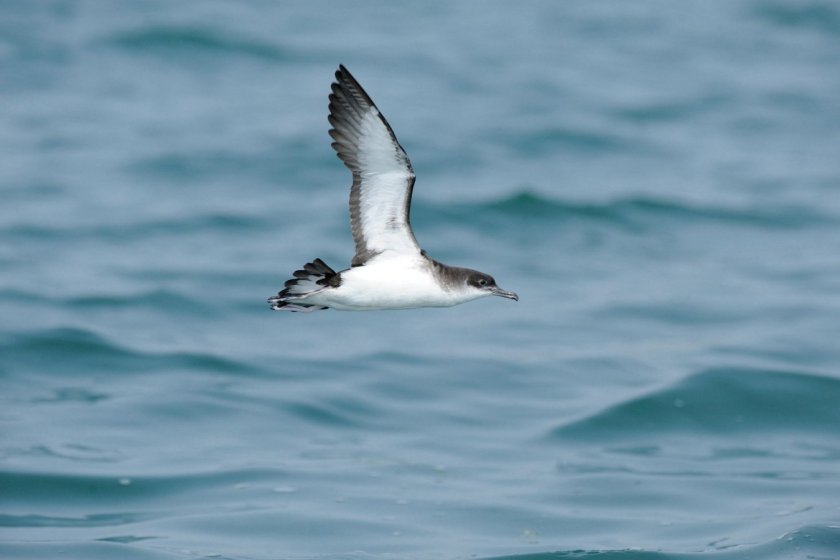
A Manx shearwater in flight low over the sea, near Wales
Nature Picture Library / Alamy Stock Photo
You don’t need a jet plane to get jet lag – even feathers will do. At least one species of bird gets jet lag, in the sense that its body clock can diverge from local time by more than an hour on fast flights across the Atlantic, as revealed by navigational errors.
“We’ve slightly shied away from using the term jet lag itself, because people associate that with the health impacts of that clock shift, rather than the clock shift itself. But it’s exactly the same process that causes jet lag in people,” says Patrick Lewin at the University of Oxford. “It’s having these physiological and behavioural effects, where the birds are mistiming their behaviours.”
It is likely that other long-distance fliers, possibly including some insects and bats as well as birds, also get jet lag in the clock-shift sense, says Lewin.
Advertisement
Manx shearwaters are small seabirds that fly vast distances, using a technique called dynamic soaring to exploit wind gradients near the sea surface. “They’ve evolved this niche of being really amazing long-distance travellers,” says Lewin.
They breed on islands around the UK and Ireland. While parents are raising a chick, they may fly more than 1000 kilometres westwards to reach rich fishing grounds in the mid-Atlantic. Once they have food, they fly back in a fairly straight line, diverting only to skirt around landmasses such as Ireland.
How do they achieve these navigational feats? While some birds can sense Earth’s magnetic field, Manx shearwaters don’t appear to. Lewin’s team has confirmed this by attaching small magnets to the birds that should disrupt geomagnetic navigation. They had no effect.
Instead, it appears that shearwaters rely on a sun compass – if you know what time it is, you can maintain a course by adjusting your orientation relative to the sun. Many animals, from insects and fish to turtles and birds, have been shown to do this. If their internal clocks are reset using artificial light and darkness, they head in the wrong direction.
“We realised that there might be a kind of natural experiment where the birds were manipulating their own clocks,” says Lewin.
For instance, at 6am, a Manx shearwater wanting to fly eastwards back to its nest needs to head sunwards. At noon, it needs to fly at right angles to the sun, which will be due south. But if a shearwater travels 15° of longitude eastwards, the local time will be 1pm, while its internal clock will still register the time as noon, so the sun will no longer be due south. This means birds flying rapidly east should veer slightly off course in a clockwise direction over the course of day, in the absence of other cues.
Other researchers have been attaching GPS trackers to Manx shearwaters for decades, so the paths taken on nearly 4000 foraging trips are known. Sure enough, when Lewin and his colleagues analysed these flight tracks, they found birds on rapid return flights tended to deviate clockwise when out of sight of land.
The team considered other potential explanations, from the Coriolis effect to winds. “The one thing that best predicted the observed changes in shearwaters’ orientation was always this sun compass effect,” says Lewin.
The effect is small. After a 1000 km flight, a bird would have to fly only an extra 5 km to reach its colony, which, for such efficient long-distance fliers, is probably negligible, Lewin says. This might explain why Manx shearwaters haven’t evolved some mechanism for avoiding jet lag, he says.
“What is good about the study is that they analyse a lot of tracks, making for robust data to test different models,” says Ken Cheng at Macquarie University in Sydney.
While other species may get this form of jet lag, too, long-distance flights by birds are typically done during migrations, and migrations usually involve mainly north-south travel, says Cheng, so jet lag won’t be much of a problem.
However, near the poles, the travel distance required to cross 15° or more of longitude becomes so short that many animals might be affected, says Lewin, perhaps even including polar bears or Arctic foxes travelling on sea ice.
“Near-polar species may be quite strongly affected,” he says. “Now, it all gets a bit complicated because you have 24-hour daylight and 24-hour darkness in parts of the year, so circadian rhythms break down generally in some species.”